
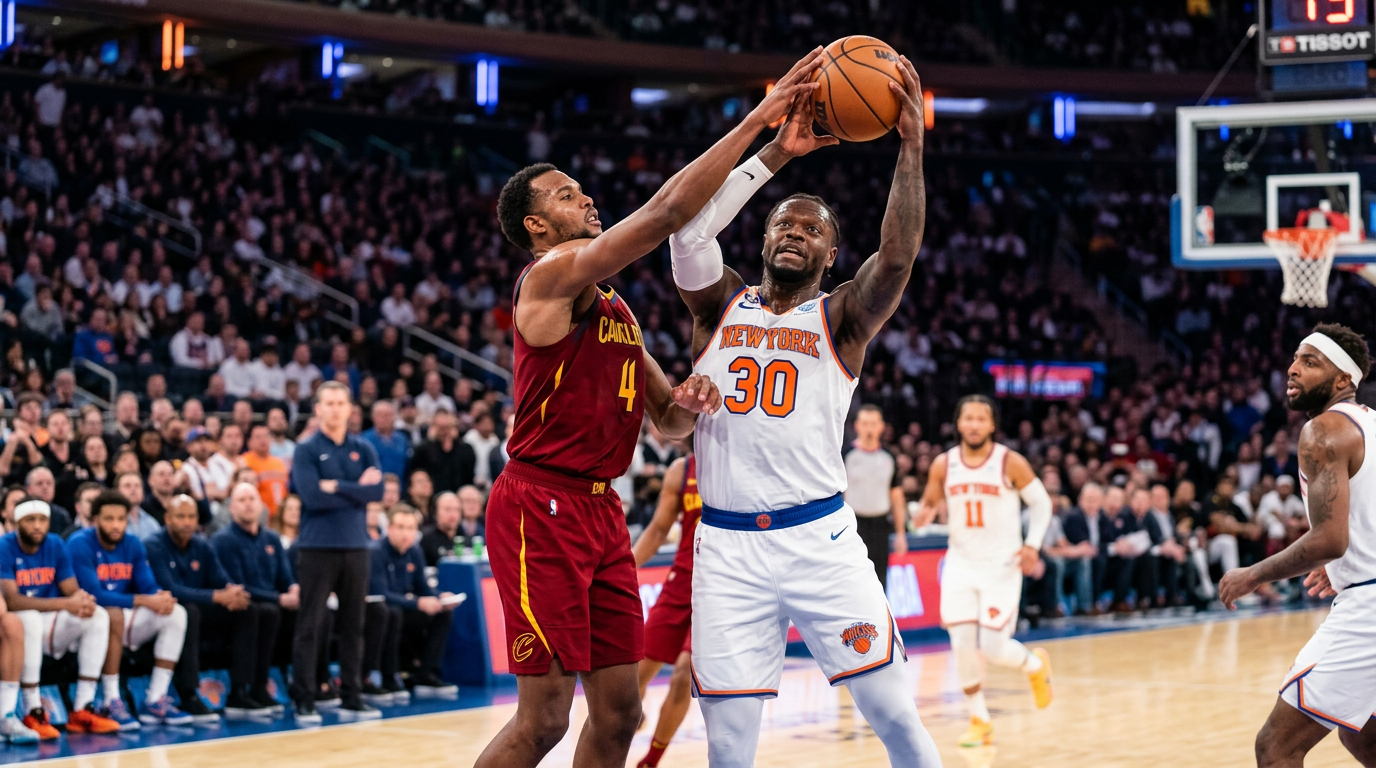
A single day of trading just moved more than a million and a half dollars in a market that had previously been a quiet corner of the NBA prediction space. Within the last twenty-four hours, $1,617,325 has changed hands as traders grapple with the upcoming clash between the Cleveland Cavaliers and the New York Knicks. This is not merely a flurry of activity. It is a loud, liquidity-driven declaration that the smart money—or perhaps just the loudest money—believes the lights of Madison Square Garden will blind the visiting Cavaliers.
The current pricing assigns the Knicks a 65% probability of victory. For those unaccustomed to the cold arithmetic of the prediction floor, this means a contract on a New York win costs 65 cents to return a dollar. Conversely, the Cavaliers are trading at a significant discount, with a YES price of just 36%. This implies that for every dollar someone is willing to put behind Cleveland, the crowd believes there is only about a one-in-three chance they will actually collect. The disparity is striking. It suggests a level of confidence in the Knicks that defies the typical unpredictability of a high-stakes May matchup.
Total volume has ballooned to $1,674,934, confirming that the recent spike represents nearly the entirety of the market’s conviction. When this much capital flows into a single outcome in such a short window, we are no longer looking at casual fan sentiment. We are seeing institutional-sized positioning. The Knicks have become the consensus play, buoyed by a home-court advantage that traders are pricing as if it were an immutable law of physics. New York’s defensive rating at home this season has hovered around 110.2, a stifling figure that clearly weighs heavily on the minds of those holding NO contracts on Cleveland.
However, the 36% valuation on the Cavaliers feels like a miscalculation of risk. Cleveland has spent the better part of the season proving they are more than a collection of talented individuals; they are a cohesive unit that thrives when the pace slows down. Donovan Mitchell’s scoring average of 28.7 points per game against Eastern Conference rivals suggests he is unlikely to be intimidated by the Manhattan crowd. The market is effectively saying that Mitchell and company have a lower chance of winning than a coin flip with a weighted edge. That is a bold stance to take against a team with Cleveland’s defensive pedigree.
The Madison Square Garden Tax
Much of this 65% confidence is rooted in the intangible atmosphere of the Garden. In financial terms, we call this a premium. Traders are paying a premium to back the Knicks because the narrative of New York’s dominance in the postseason is seductive. It is easier to buy into a roaring crowd and a physical, Tom Thibodeau-led defense than it is to bet on the clinical, often understated execution of the Cavaliers. But premiums can be dangerous. When a price reaches 65% in a game that many analysts view as a statistical toss-up, the value begins to drain out of the favorite and pool into the underdog.
The sheer velocity of the $1.6 million 24-hour volume suggests a fear of missing out among high-net-worth traders. They see the Knicks’ momentum and they want a piece of the action before the price climbs even higher. This creates a feedback loop. As more money flows into the Knicks, the price rises, which in turn attracts more momentum traders who see the rising price as a signal of certainty. It is a classic case of price action driving sentiment rather than the other way around. The fundamental reality of the matchup—two teams separated by only a handful of games in the regular season standings—is being buried under a mountain of capital.
Statistical Reality Versus Market Sentiment
Look at the numbers that are not reflected in the YES price. The Cavaliers have maintained a top-five defensive efficiency rating throughout the spring. They specialize in taking away the very mid-range opportunities that the Knicks’ offense relies upon. If the game becomes a grinding, low-scoring affair, the 36% chance currently afforded to Cleveland will look like a historical bargain. The market is pricing this game as if it were a foregone conclusion. It is not. Basketball games at this level are decided by single possessions and late-game execution, variables that rarely justify a 65-36 split between two high-tier competitors.
The conviction shown in the trading volume cannot be ignored. $1.6 million is a serious sum. It represents a level of commitment that usually precedes a major event. Yet, the history of these markets is littered with examples of the crowd being wrong at high volume. The "Garden Premium" is a real phenomenon, but it is often an emotional one. Traders who are buying the Knicks at 65 cents are betting on the noise. Those who are buying Cleveland at 36 cents are betting on the math. In the long run, the math tends to be a more reliable partner than the roar of a crowd in Midtown Manhattan.
As the clock ticks toward 8:00PM ET on May 21, expect the volatility to continue. If Cleveland starts strong, the rush to exit Knicks positions will be frantic, and that 65% price will collapse as quickly as it rose. For now, the market has made its choice. It has chosen the bright lights and the home-team hype. Whether that choice is backed by anything more than a sudden influx of optimistic capital remains to be seen. The scoreboard will provide the final audit of these million-dollar opinions.



Comments
to join the conversation.
No comments yet. Be the first to share your thoughts.