
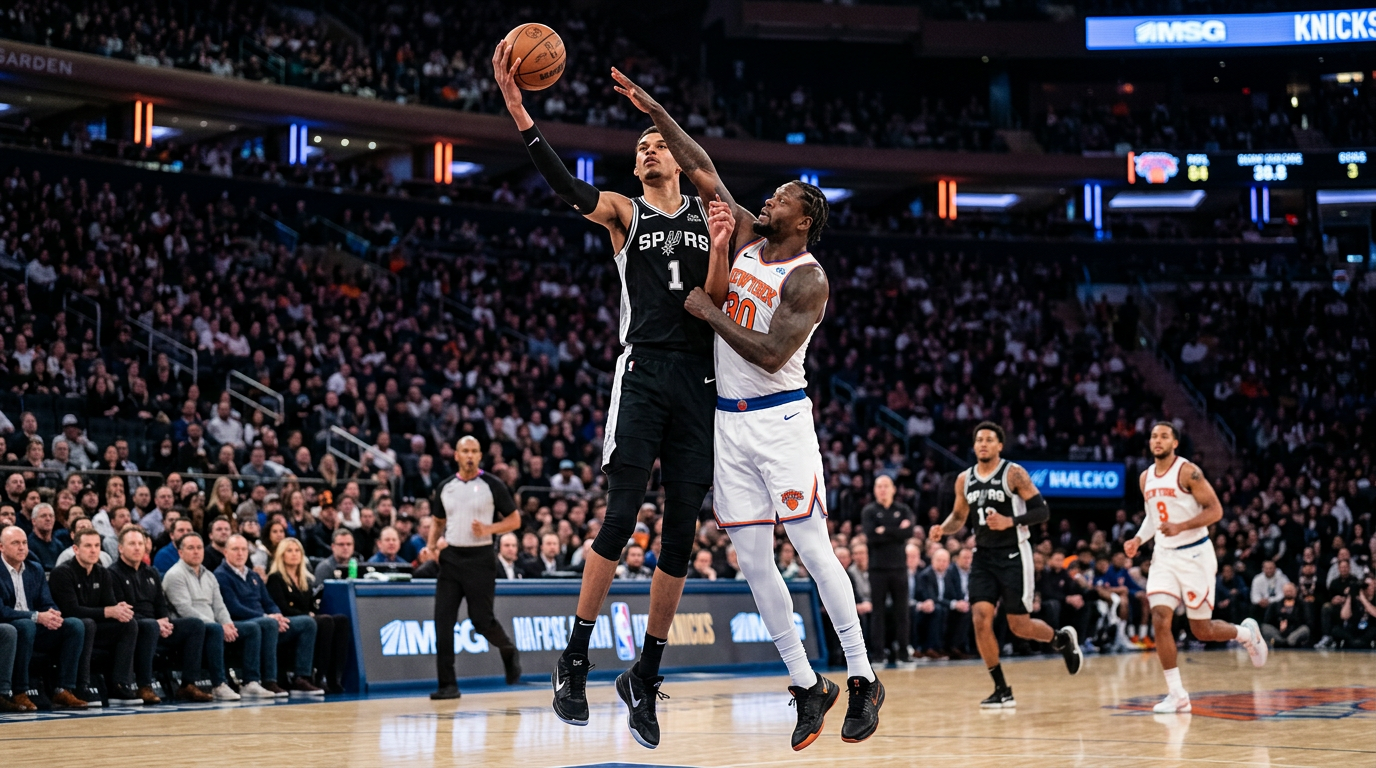
Four million dollars is an exceptionally loud way to tell the San Antonio Spurs they are overvalued. In the last twenty-four hours, the prediction market for the June 8 clash between the Spurs and the New York Knicks has seen a frantic influx of capital, with $4,780,145 in fresh trades pushing the total volume north of $6.1 million. This isn't just casual interest from the cheap seats. This is a liquidity event that suggests institutional-grade conviction. The numbers have shifted accordingly, pinning the Spurs at a 46% implied probability of victory. It is a price that reflects lingering respect for individual brilliance, but one that is increasingly being crushed by the weight of New York’s collective efficiency.
At 46%, a share in a Spurs victory costs 46 cents and pays out a dollar if they win. Conversely, the "No" side—effectively a bet on a Knicks victory—is trading at 55 cents. The math is simple and cold. The market currently views the Knicks as the definitive favorite, affording them a nine-percentage-point lead in what was, only forty-eight hours ago, a statistical dead heat. The shift follows a pattern we have seen throughout this postseason cycle: the public buys the Wembanyama mythos, but the whales buy the Knicks’ defensive rotation. Sentiment is a luxury that serious traders cannot afford.
Context matters here. The Knicks have maintained a defensive rating of 104.2 across their last ten outings, a figure that leads the league and suggests a team that has perfected the art of the grind. They do not beat themselves. While the Spurs rely on the gravitational pull of Victor Wembanyama to distort opposing defenses, the Knicks have spent the season building a perimeter wall that few can scale. San Antonio’s offense has sputtered in high-pressure road environments, shooting a dismal 32% from beyond the arc when the game enters the final six minutes. This lack of late-game execution is precisely what the smart money is fading.
The Gravity of Professional Capital
The sheer velocity of the recent trading volume indicates that this price move is not a fluke. When nearly 80% of a market’s total volume occurs in a single day, it usually signals that a major actor or a sophisticated syndicate has moved their position. These are not emotional fans in San Antonio jerseys. These are participants responding to the reality of the Knicks’ superior depth and the Spurs’ reliance on a single, albeit tall, point of failure. The market is correcting for the "superstar premium" that usually inflates the Spurs' price beyond any rational baseline.
Jalen Brunson’s efficiency remains the primary structural advantage for New York. His ability to manipulate the pick-and-roll against a drop coverage defense has rendered the Spurs' length largely irrelevant in previous matchups. Prediction markets are often more accurate than traditional sportsbooks because they allow for this kind of granular, real-time price discovery. Right now, the price discovery suggests that the Knicks are not just winners, but a safer harbor for capital than the volatile Spurs. The 55% price on the Knicks side might actually be a bargain if you consider their 12-3 record in games following three days of rest.
The Spurs remain a high-variance play. Betting on a 46% underdog requires a belief in a statistical outlier—a performance where Wembanyama transcends the limitations of his supporting cast. While the highlight reels suggest this is a weekly occurrence, the spreadsheets suggest otherwise. The Knicks have the personnel to absorb a 30-point performance from a superstar and still win by double digits through sheer attrition. They are the basketball equivalent of a blue-chip stock that pays a steady dividend of forced turnovers and offensive rebounds.
Expect the price to narrow slightly as the June 8 tip-off approaches and retail money attempts to find value in the underdog. However, the heavy lifting has already been done by the big hitters. The Knicks are the rightful favorites in a market that has finally decided to prioritize results over potential. San Antonio has the future, but New York has the present. Traders who ignore that distinction are likely to find themselves on the wrong side of the ledger when the final whistle blows at Madison Square Garden.



Comments
to join the conversation.
No comments yet. Be the first to share your thoughts.